Wikipedia has an article "Pythagorean triple".

It contains a lot of useful information, but what draws my particular attention is this sentence in the section "Spinors and the modular group":
The group Γ(2) is the free group whose generators are the matrices
Consequently, every primitive Pythagorean triple can be obtained in a unique way as a product of copies of the matrices U and L.

We will call these matrices U2 and L2. I really like the matrix U2. Here is a piece from page 96 of my book Quantum Fractals.


We will be dealing with matrices. While it is a plausible hypothesis that God created the integers (see my previous post "The magic of numbers 3,4,5", it is not clear who invented matrices with their noncommutative multiplication rule. Till now nothing is known about matrices being featured in the Bible, Talmud or Babylonian tablets. The online paper "When was Matrix Multiplication invented?" informs us that:
1850 Sylvester first use of term "matrix" (matrice=pregnant animal in old french or matrix=womb in latin as it generates determinants)
1858 Cayley matrix algebra [7] but still in 3 dimensions [14]
1888 Giuseppe Peano (1858-1932) axioms of abstract vector space [12]
I will assume that the Reader is acquainted with matrix multiplication. We will be dealing here first with 2x2 matrices: two rows and two columns. Then with 3x3 matrices, then with 4x4 matrices, then ... the future will tell. Matrices will have real or complex entries, but we will will be particularly interested in matrices with integer entries. The matrix U2 above has integer entries 0,1,2. Our cat Pikabu knows this matrix pretty well.
There is a particular matrix with integer entries, we call it E. Wikipedia calls it the identity matrix and denotes it by the capital letter I:
The identity matrix is often denoted by , or simply by if the size is immaterial or can be trivially determined by the context.[1]


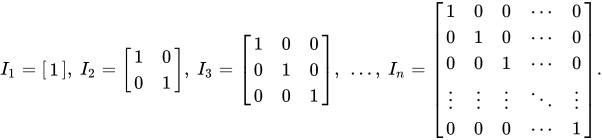
If A and B are square (the same number rows and columns) their matrix product (in the order written) is denoted AB. In general AB is not the same as BA. For an arbitrary matrix A and the identity matrix we have though AE=EA=A. If A,B are two matrices and AB=E, one can prove that then also BA=E. The matrix B with this property is unique and called the inverse A. Quoting Wikipedia again:
In linear algebra, an n-by-n square matrix A is called invertible (also nonsingular, nondegenerate or (rarely used) regular), if there exists an n-by-n square matrix B such that
where In denotes the n-by-n identity matrix and the multiplication used is ordinary matrix multiplication.[1] If this is the case, then the matrix B is uniquely determined by A, and is called the (multiplicative) inverse of A, denoted by A−1. Matrix inversion is the process of finding the matrix B that satisfies the prior equation for a given invertible matrix A.

Here Wikipedia is using bold letters to denote matrices. We will use normal letters. We will also need the concept of the determinant and trace. Exploiting the handy Wikipedia again:
The determinant of a 2 × 2 matrix is
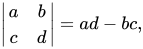
The trace Tr(A) of the matrix A is simply the sum of all its diagonal elements. In the acse of the 2x2 matrix above
Tr(A ) = a+d.
There is a beautiful little paper by Roger C. Alperin "The Modular Tree of Pythagoras", p.807, we notice the following interesting sentence


